A streamlined workflow for reliable immunization data
In Niger, teams faced a challenging context with fragmented, non-integrated data systems, which limited timely access to information for decision-makers and affected their ability to respond effectively. To address this, automated immunization reporting was built using OpenHEXA. These reports are generated from data files shared by the Direction des Immunisations and are made available directly in the workspace or distributed by email. Using the same datasets and indicators, interactive dashboards were also developed in Power BI.
This shift from manual data consolidation to structured OpenHEXA pipelines has reduced workload and its objective is to enable regions to better identify bottlenecks, strengthen accountability, and improve the adaptive management of EPI (= PEV in the visual) services. It does so by providing a structured and reliable workflow for data validation, indicator computation, and report generation.
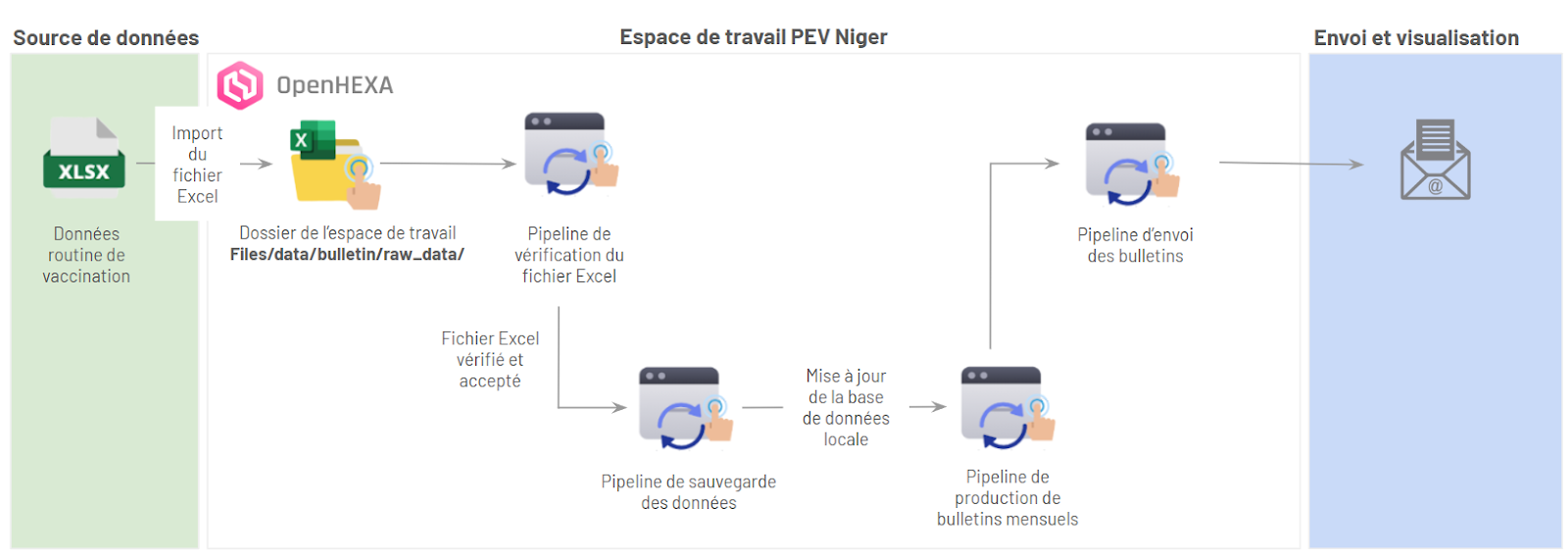
OpenHEXA process: from data sources to sending & visualization
Step 1: upload and validate routine immunization data
The process begins with uploading the routine immunization data file into the dedicated folder in OpenHEXA. A first pipeline verifies that the file is structurally sound, checks the presence of mandatory columns, and ensures that all values follow the expected format.
If the pipeline runs successfully, the file is marked as validated and automatically transferred to the next storage folder. In case of errors, the system displays targeted messages indicating what needs to be corrected in the Excel file. Users can then re-upload the corrected version and relaunch the validation pipeline.
Step 2: compute indicators and store clean data
A second pipeline calculates all indicators required for the immunization performance bulletins. Once computed, the indicators are stored securely in OpenHEXA’s local database, ensuring consistency across all future analyses and automated dashboards.
Step 3: generate monthly reports at all administrative levels
With validated data and computed indicators, users can trigger a third pipeline that automatically generates the performance bulletins. These reports can cover a specific month and produce outputs at national, regional, and district levels.
Users then have two options:
- Download the files directly from the OpenHEXA workspace
- Trigger an email-distribution pipeline that automatically sends the reports to a predefined mailing list
In most workflows, at least three manual pipeline executions are required: one for validation, one for indicator computation, and one for report generation (plus the optional email distribution).
Flexible pipelines designed for real-world data flows
In practice, data collection cycles may not always be consistent. The OpenHEXA pipelines were therefore designed to handle incomplete or delayed submissions. Even if some months’ data are missing, the system will automatically detect and insert only the new entries from the latest uploaded file.
For example, users may skip uploading data for May and June. In July, they can upload a file covering January to July. The pipelines will insert only the missing months—May, June, and July—into the database, as long as they appear in the uploaded file. This flexibility ensures data continuity without adding extra administrative burden.
A secure and collaborative environment for project teams
Beyond automation, the reliability of this reporting system also depends on strict data governance. OpenHEXA workspaces ensure that datasets, code, and pipelines are properly organized and accessible only to authorized users.
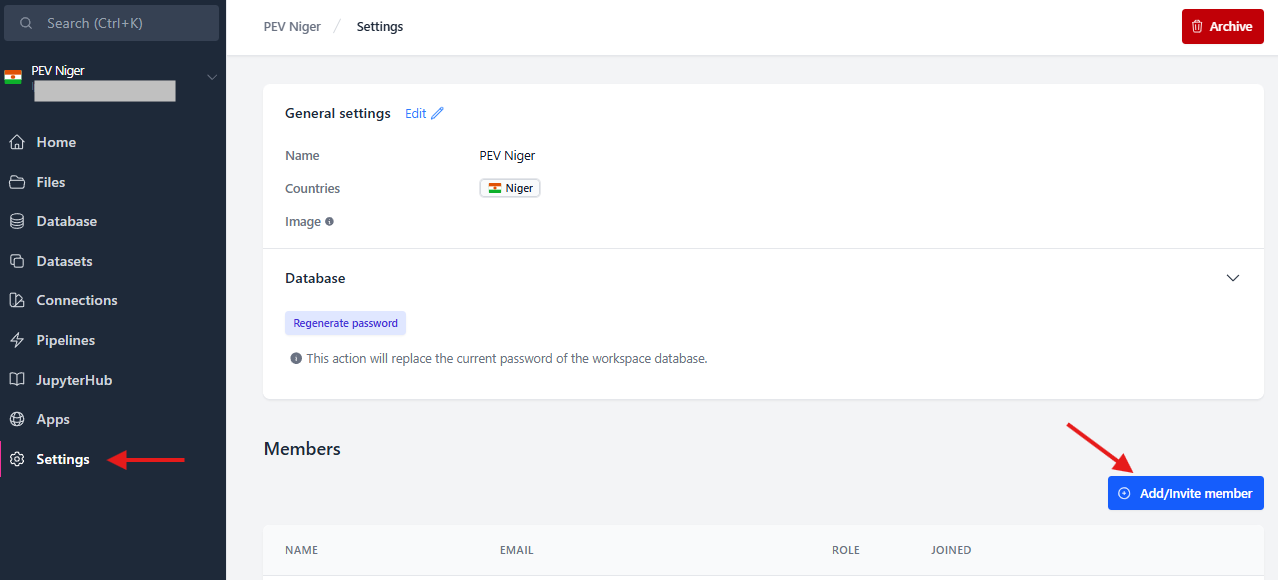
EPI workspace on OpenHEXA
Each workspace includes three user roles:
- Administrator: full access, including the ability to invite and manage team members
- Editor: can consult and modify content
- Viewer: can view content but cannot modify it
Assigning the correct access rights is essential to protect critical data and prevent accidental modification or deletion of pipeline configurations or project assets. Only administrators and project managers should oversee role management.
Empowering Niger’s health system through automated insights
The implementation of automated immunization performance reports marks an important step toward stronger immunization monitoring in Niger. By combining robust data validation, automatic indicator computation, flexible month-to-month ingestion, and secure workspace management, Bluesquare’s OpenHEXA-based system delivers timely, reliable insights directly to the district and regional teams who need them most.
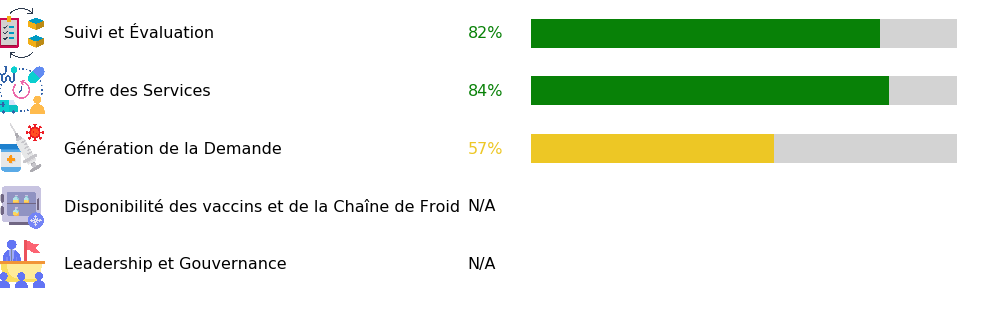
Automated reports generated by OpenHEXA
This integrated approach supports more responsive decision-making, enhances accountability, and ultimately contributes to stronger routine immunization services across the country.